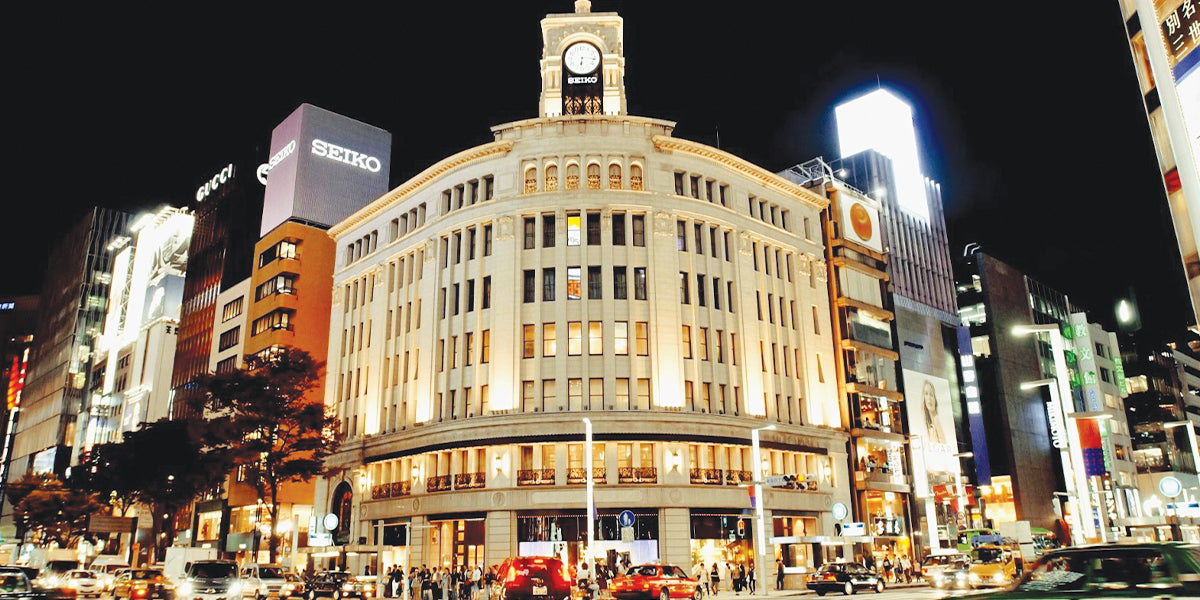
Ginza gets compared to Fifth Avenue and Bond Street, which undersells it. What makes the district interesting isn't the concentration of international labels — you have those at home — but the fact that a 350-year-old department store, an avant-garde concept shop and a hand-built stationery or knife specialist sit within a few blocks of each other.
You cannot see Ginza properly in an afternoon of walking past windows. Three places we'd choose instead.

1. Ginza Six
Opened in 2017 and designed by Yoshio Taniguchi, Ginza Six is the modern anchor of the district: a large complex built around a full-height atrium, with rotating art installations, a Noh theatre, a rooftop garden and something over 240 stores.
The reason to come isn't the international houses on the lower floors. It's the Japanese labels — Sacai, Undercover and others — alongside the food hall, which is a serious one.
Our advice: go up before you go across. The rooftop garden is free, usually quiet, and gives you a sense of the district's scale that street level does not.

2. Mitsukoshi
Founded in 1673 as a kimono merchant, Mitsukoshi became Japan's first department store and still behaves like an institution rather than a mall. The Ginza branch is marked by its lion statues at the entrance.
The floors ascend from the food hall through kimono, jewellery and international fashion, and the service culture on each of them is worth experiencing even if you buy nothing.
Our advice: the basement food hall is the real destination. Depachika at this level are among the best food experiences in Japan and cost the price of a bento. Tax-free processing is available for visitors, but it's handled at a dedicated counter rather than at the till — keep your passport and your receipts together.

3. Dover Street Market
Rei Kawakubo's concept store is less a shop than an installation you can buy from. Industrial fittings, sculptural displays, and a layout that changes regularly enough that regulars come back to see what moved.
Gucci and Saint Laurent are here, but the point is the emerging designers and the collaborations you won't find elsewhere.
Our advice: it isn't for everyone, and we'd say so plainly. If you want to shop efficiently, skip it. If you're interested in how retail can be designed, give it an hour.
A note on the rest of Ginza
The three above are the anchors, but the district's real character is in the smaller specialists on the side streets — stationery, knives, ceramics, brushes — many of them family businesses several generations deep. They keep shorter hours than the big stores and often close one weekday. Build them into the morning rather than hoping to find them at six in the evening.
If shopping is a real part of your trip rather than an afternoon's browsing, tell your Elite Tokyo Tours tour manager what you're looking for before the itinerary is set. We'll work the right specialists into the day, at hours when they're actually open, and arrange for purchases to go back to your hotel rather than around Tokyo with you.